
Introduction
The demand for flexible higher education options has increased significantly in recent years. Many students are unable to complete their graduation due to financial constraints, family responsibilities, career commitments, health issues, or personal circumstances. As a result, terms like BCA One Sitting Degree have become increasingly popular among students looking to complete their education and improve their career prospects.
However, there is considerable confusion surrounding the concept of a BCA One Sitting Degree. Many students believe they can obtain a Bachelor of Computer Applications (BCA) degree by simply appearing for one examination. Others are unsure about the validity, recognition, admission process, and career opportunities associated with such programs.
What Is a BCA One Sitting Degree?
A Bachelor of Computer Applications (BCA) is an undergraduate degree focused on computer science, software development, programming, databases, networking, and information technology.
The term "One Sitting Degree" is commonly used in the education sector to describe flexible academic pathways that help students complete their graduation, especially if they have previously discontinued their studies.
These pathways may include:
Credit Transfer
Lateral Entry
Recognition of Prior Learning
Open and Distance Learning (ODL)
Online Learning Programs (where permitted)
The exact structure depends on university regulations and eligibility requirements.
It is important to understand that legitimate universities do not award degrees without academic evaluation and fulfillment of required coursework.
Who Can Apply for a BCA One Sitting Degree Program?
BCA One Sitting Degree pathways are often considered by:
Dropout Students
Students who started a BCA program but could not complete it due to personal or financial reasons.
Working Professionals
Individuals already employed in IT or non-IT sectors who need a graduation degree for career growth.
Students with Academic Gaps
Learners who have taken a break from education and want to resume their studies.
Career Changers
Individuals seeking qualifications that may help them transition into technology-related fields.
Admission eligibility varies by institution and program.
Eligibility Criteria
Although eligibility requirements differ among universities, applicants generally need:
Educational Qualification
Completion of 10th standard
Completion of 12th standard or equivalent
Previous Academic Records
For credit transfer or lateral entry pathways, students may need:
Previous BCA mark sheets
Semester-wise results
Transfer certificates
Migration certificates
Identity Documents
Aadhaar Card or government-issued ID
Passport-size photographs
Address proof
Universities evaluate eligibility based on their admission policies.
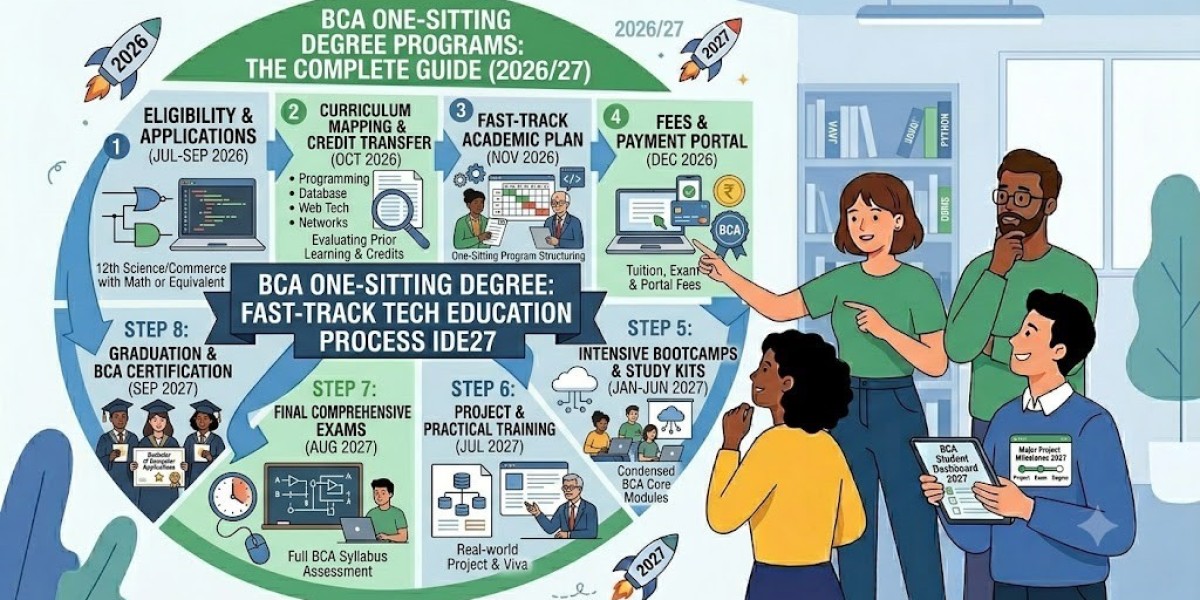
How Does the Admission Process Work?
Step 1: Research Recognized Institutions
Students should verify whether the institution and program are recognized under applicable regulations.
The Distance Education Bureau (DEB) advises students to confirm the recognition status of institutions and programs before taking admission. Recognition status may vary from one academic session to another.
Step 2: Check Eligibility Requirements
Review admission criteria carefully and determine whether you qualify based on previous education and academic records.
Step 3: Submit the Application
Most institutions provide online admission portals where students can submit:
Personal details
Academic information
Required documents
Step 4: Academic Evaluation
Universities may review:
Previous qualifications
Credit transfer eligibility
Academic gaps
Supporting documents
Step 5: Fee Payment
After successful verification, students complete the admission process by paying the applicable fees.
Step 6: Enrollment Confirmation
Once approved, students receive:
Enrollment number
Student credentials
Course information
Academic schedule
Is a BCA One Sitting Degree Valid?
This is one of the most frequently asked questions.
The validity of any BCA degree depends primarily on:
Recognition of the university
Recognition of the specific program
Compliance with academic regulations
According to UGC regulations, undergraduate and postgraduate degrees earned through recognized Open and Distance Learning (ODL) and Online modes are treated as equivalent to corresponding degrees offered through conventional mode.
Students should always verify the current recognition status of both the institution and the program before enrolling.
Common Myths About BCA One Sitting Degree Programs
Myth 1: You Can Earn a Degree Without Studying
Reality: Legitimate institutions require students to fulfill academic requirements, complete evaluations, and meet program standards.
Myth 2: These Degrees Are Not Valid
Reality: Degrees awarded by recognized institutions through approved academic frameworks can be valid, subject to applicable regulations.
Myth 3: Employers Reject Such Degrees
Reality: Employers generally focus on skills, experience, and the legitimacy of the qualification.
Myth 4: Only Weak Students Choose Flexible Learning
Reality: Many working professionals and career-focused learners choose flexible education to balance studies with other responsibilities.
Benefits of BCA One Sitting Degree Programs
Flexible Learning
Students can often study while managing work and family commitments.
Educational Continuity
Dropout students may be able to continue their education rather than starting over.
Career Advancement
Graduation can help meet eligibility requirements for many jobs and promotions.
Cost-Effective Education
Many flexible learning options are more affordable than traditional full-time programs.
Access to Higher Education
A bachelor's degree can serve as a foundation for further studies.
Career Opportunities After BCA
A BCA degree can support careers in various technology and business sectors.
Potential career paths include:
Software Developer
Developing applications, websites, and software solutions.
Web Developer
Designing and maintaining websites and web applications.
Technical Support Specialist
Providing technical assistance to users and organizations.
Database Administrator
Managing and maintaining organizational databases.
IT Support Executive
Supporting hardware, software, and network operations.
System Administrator
Managing servers and IT infrastructure.
Digital Technology Roles
Many organizations seek graduates with foundational computing knowledge and technical skills.
Actual employment opportunities depend on skills, certifications, experience, and market conditions.
Can You Pursue Higher Education After BCA?
Many BCA graduates continue their education through programs such as:
MCA (Master of Computer Applications)
MBA
MSc in Information Technology
Data Science Certifications
Cybersecurity Programs
Cloud Computing Certifications
Artificial Intelligence Courses
Admission requirements vary by institution.
Skills Every BCA Student Should Learn
Regardless of the learning mode, students can strengthen their employability by developing practical skills such as:
Programming Languages
Python
Java
C++
JavaScript
Database Management
Understanding SQL and database systems.
Web Development
Learning front-end and back-end development.
Cloud Computing
Building familiarity with cloud platforms and services.
Cybersecurity Basics
Understanding digital security concepts.
Problem-Solving Skills
Developing analytical and logical thinking abilities.
Employers often value practical skills alongside academic qualifications.
How to Choose the Right BCA Program
Before applying, students should:
Verify Recognition
Check the institution's recognition status through official sources.
Understand the Academic Structure
Review examinations, assignments, practical requirements, and evaluation methods.
Compare Costs
Evaluate tuition fees, examination charges, and other expenses.
Assess Student Support
Consider learning resources, faculty support, and technology platforms.
Avoid Unrealistic Promises
Be cautious of advertisements claiming:
Instant degrees
No examinations
Guaranteed graduation
Degrees without academic requirements
Legitimate institutions maintain academic standards and verification processes.
Important Precautions Before Admission
Students should always:
Verify university recognition.
Confirm program recognition.
Review admission guidelines.
Understand examination requirements.
Check academic regulations.
Retain copies of all submitted documents.
The DEB specifically advises students to verify recognition status for the session in which they seek admission because recognition can change over time.
Conclusion
BCA One Sitting Degree programs are often misunderstood due to misleading marketing and lack of awareness. In reality, these pathways generally refer to flexible educational options such as credit transfer, lateral entry, Open and Distance Learning, and online education frameworks that help eligible students complete their graduation.
The most important consideration is not the term "One Sitting Degree" itself, but whether the institution and program are recognized and comply with applicable academic regulations. Recognized ODL and online degrees can be treated as equivalent to conventional degrees when offered by institutions approved under UGC regulations.
By researching carefully, verifying recognition status, and choosing a reputable institution, students can make informed decisions and take meaningful steps toward their educational and professional goals.